
Single-use systems versus stainless steel: choosing the right bioprocess equipment
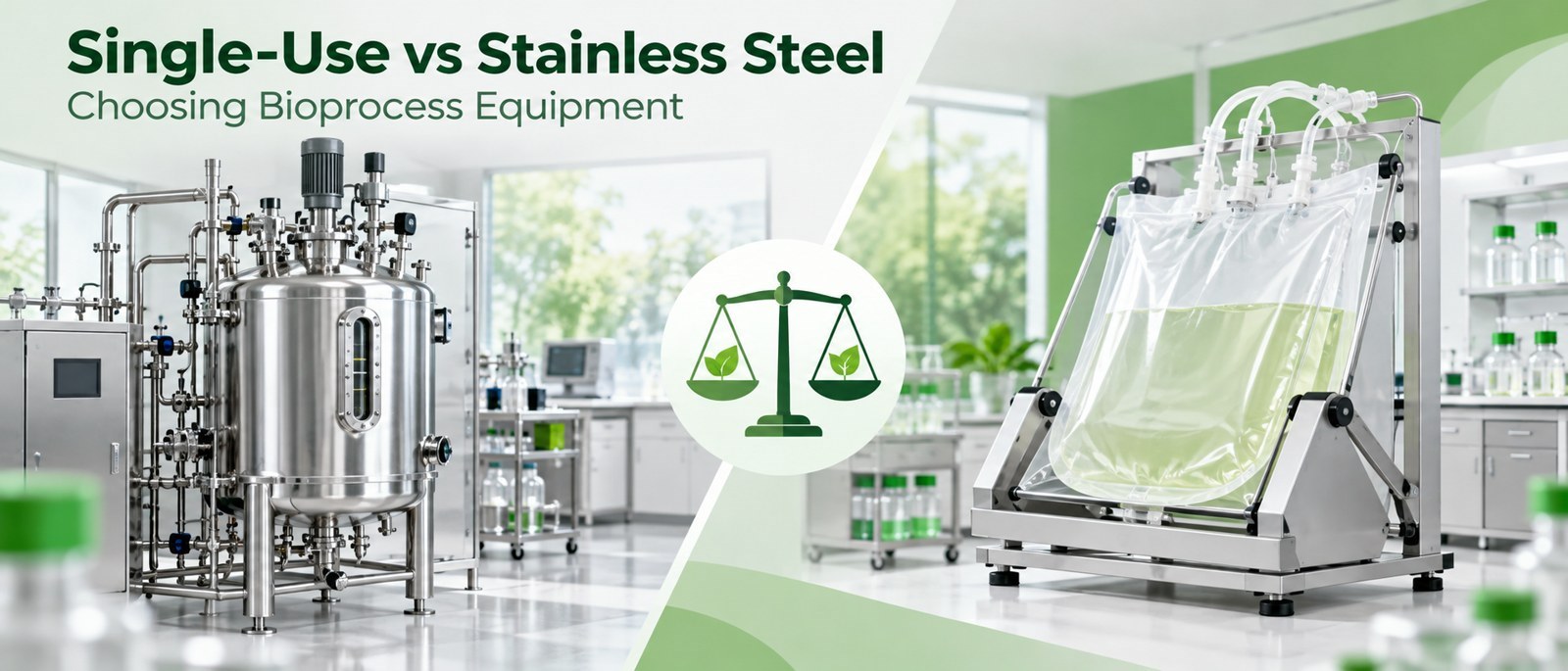
A decision framework for single-use, stainless steel and hybrid bioprocess equipment, using Annex 1 section 8.131 to 8.139, a 2015 risk management paper and a 2026 carbon footprint study, as of 27 November 2026.
The single-use versus stainless steel question is usually framed as cost against flexibility. Three of the better-documented parts of the decision are quality risk, supply, and environmental footprint, and on the last of these a July 2026 paper has changed a long-held assumption. This article uses EU GMP Annex 1 (2022 revision), a Japanese industry and regulator risk management paper on single-use systems published in AAPS PharmSciTech in 2015, and a 2026 bottom-up carbon footprint study in Biotechnology and Bioengineering.
Last reviewed: 27 November 2026. Comparable capital or operating cost figures are not available in the cited material, so none are quoted and cost is treated as a plant-specific input to the decision. Passages marked as interpretation are the author's analysis.
What single-use brings, and what it asks of the quality system
The 2015 paper lists the advantages as increased manufacturing efficiency, prevention of cross-contamination in the manufacture of high-potency compounds, flexibility to make multiple products, and no need for cleaning and steam sterilisation or their validation, and notes that the approach also raises new issues for process control and product quality assurance. The 2026 study adds faster changeover and reduced cross-contamination risk as operational advantages and the generation of plastic waste as the trade-off.
Annex 1 defines single-use systems as technologies used in sterile manufacture as an alternative to reusable equipment, made of components such as bags, filters, tubing, connectors, valves, storage bottles and sensors, and says they should be designed to reduce manual interventions and complexity. Section 8.132 lists risks to assess in the contamination control strategy: product and surface interaction including adsorption, leachables and extractables; fragility compared with fixed systems; more and more complex manual operations and connections; assembly complexity; pre- and post-use integrity testing of sterilising-grade filters; holes and leakage; compromise on opening the outer packaging; and particle contamination.
Extractables, leachables, particles, integrity and suppliers
The Annex 1 provisions give a checklist that applies whatever the scale. Sterilisation of single-use systems should be validated with no adverse effect on performance (8.133). Supplier assessment including sterilisation is described as critical, with sterility assurance verified during supplier qualification and evidence of sterilisation checked on receipt for each unit (8.134). Product adsorption and reactivity with contact surfaces should be evaluated under process conditions (8.135). Extractable and leachable profiles should be evaluated for each component for applicability, with leachable studies considered for high-risk components such as those that absorb processed materials or have long contact times, and simulated conditions must reflect actual processing (8.136). Integrity should be maintained under the intended conditions, including freezing and thawing and transport, with verification that intrinsic sterile connectors stay integral (8.137). On receipt, units should be checked against the approved specification, including outer packaging, label printing, certificate of conformance and proof of sterilisation (8.138), and critical manual handling such as assembly and connection should be verified during aseptic process simulation (8.139).
The 2015 paper adds practice on the supplier relationship. It suggests suppliers disclose as much as possible about the source of chemicals and quality controls, and that users disclose the use conditions so the component is not used outside its validated range. Examples of what users tell suppliers include the general composition, pH, protein concentration, volume, temperature and viscosity of solutions that contact the component, and conditions such as maximum and minimum temperature, contact time, pump use, maximum pressure, autoclave sterilisation, flushing, stirring and filter integrity testing. It also says deviations such as leakage or misconnection should have predefined responses under the deviation SOP, with CAPA and re-evaluation of the component as appropriate.
Supply continuity
The 2015 paper treats stable supply as a quality risk. Leachables from cell culture bags can affect cell growth and metabolism, and handling factors such as transport, storage, unpacking, set-up and connection, along with operator skill, can cause leaks or loss of sterility and indirectly disrupt supply. It says the certainty of the component supply chain also matters and that these factors should be identified and risk assessed. The cited material gives no data on bag shortages or second-source practice, so no claim is made on that.
Interpretation: the Annex 1 supplier provisions and the 2015 disclosure advice point to a practical rule for supply continuity. A change of component, supplier or sterilisation route is a change to the validated system, so a second source is not a simple substitution and should be qualified before it is needed.
Waste, water, energy and carbon: the 2026 evidence
The 2026 study of Reiners and colleagues examines a 2000 L scale using two real facility case studies, a full single-use model and a hybrid model, with physical disassembly of consumables. It reports consumables of 822 kg per batch for the full single-use process (plus about 16 percent of net weight as packaging) and 360 kg for the hybrid, equivalent to 6.5 and 2.9 tonnes of CO2 equivalent, and identifies bags, tubing and kits, and filters as the main hotspots, in particular buffer bags above 1000 L and long transfer tubing. It argues the older view that single-use is more sustainable rested on on-site water and energy savings, and that two changes challenge it: electricity grids and procurement have decarbonised, and updated emission factors for plastics are higher. In its direct comparison, for a 1200 L buffer preparation step and a 2000 L bioreactor run, stainless steel steps can have less than half the CO2 emissions of the single-use equivalents under the study's assumptions, with steam for sterilisation in place the largest stainless driver.
The authors are open about limits: the results come from two facilities, the study's emission factors depend on the site's market-based electricity accounting, and the authors describe their consumable figure as a conservative lower bound. A site with a fossil-heavy electricity supply and no renewable procurement would not get the same result.
Interpretation: the paper's strongest practical finding is not that stainless steel always wins. It is that the hybrid layout worked: stainless vessels for large volumes, concentrated buffers diluted inline into small mobile bags, and single-use kept for the core process, which cut consumable mass and removed long transfer lines while keeping flexibility.
Hybrid facilities
The study's hybrid case prepared large-volume media in existing stainless vessels and transferred it by online sterile filtration, used 10 times concentrated buffers made in stainless steel and filtered into 200 L bags, and reused some items within validated limits. The authors note this configuration evolved over time rather than from a sustainability decision, which is a reminder that hybrid is a design choice that can also be made on purpose.
A decision framework (interpretation)
These criteria suit a weighted decision matrix: product mix and campaign length, batch volume, quality risk (extractables, leachables, integrity, particles), supplier assurance, supply continuity, cleaning validation burden, waste and carbon, and operator handling risk. Weights come from the plant, since no source sets them.
Illustrative scenario
This is a made-up example, not a named company. A site making three monoclonal antibodies in short campaigns weights changeover time and cross-contamination risk heavily and chooses single-use for the 2000 L bioreactor. Its large volume buffer demand scores badly on waste and handling risk, so it prepares concentrates in stainless steel and dilutes inline. A small-volume clinical site with one product would weight capital cost and speed most, while a high-volume single-product site would weight cost per batch and waste more heavily. The weights differ, and so do the answers.
- Small volume, many products: single-use usually scores highest on flexibility and changeover.
- Mid-scale: hybrid layouts are worth scoring on their own line.
- Large volume, one product: stainless steel scores better on waste and, on the 2026 study's assumptions, carbon, while single-use keeps its flexibility case for small ancillary steps.
Related reading on Pharmaceutical Weekly: machinery, regulatory updates and biologics packaging and extractables.