
Pharma equipment qualification and validation: what changes with Annex 15 and modern automation?
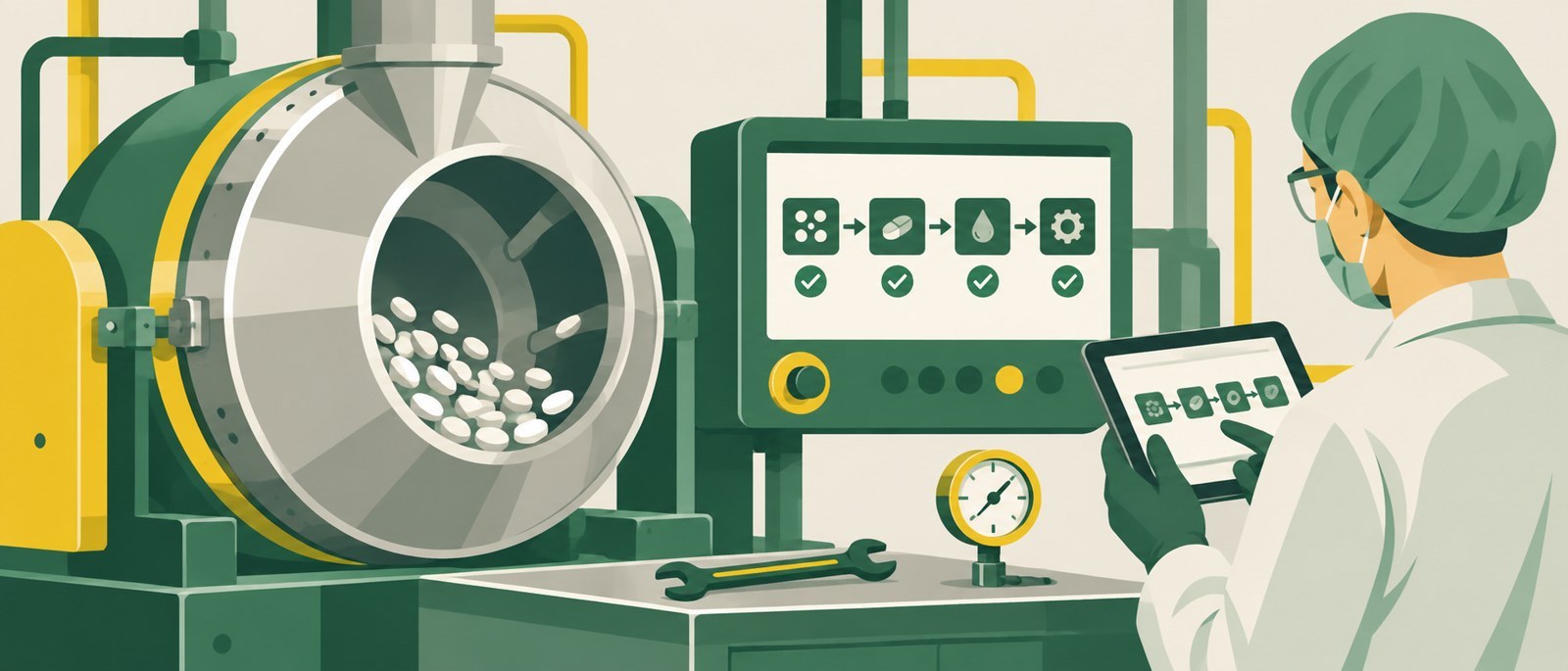
How EU Annex 15 links URS, DQ, FAT/SAT, IQ, OQ, PQ, process verification and cleaning validation, and how Annex 11 applies to automation, as of 27 November 2026.
Qualification used to be a binder that a project team finished before start-up. Annex 15 of the EU GMP guide treats it as a lifecycle: define what the equipment must do, prove that it does it, and keep proving it while the process runs and changes. Automation adds a second layer, because the control software is itself a system that has to be shown fit for purpose under Annex 11. This article walks through the stages and links them.
Last reviewed: 27 November 2026. Passages marked as interpretation are the author's analysis, not text from the Annexes. The text read is Annex 15 as published by the European Commission on 30 March 2015, with a deadline for coming into operation of 1 October 2015, and Annex 11 on computerised systems. Other regions apply their own rules.
The chain from requirement to proof
Annex 15 sets out the stages. A user requirements specification (URS) defines what the equipment, facility, utility or system must do. The essential quality elements are built in at this stage, GMP risks are reduced to an acceptable level, and the URS stays the reference point through the validation lifecycle. Design qualification (DQ) shows that the design complies with GMP and checks the URS requirements. Factory acceptance testing (FAT) may evaluate novel or complex equipment at the vendor before delivery and may be followed by site acceptance testing (SAT) on arrival. Installation qualification (IQ) comes next, then operational qualification (OQ), which includes tests of upper and lower operating limits or worst-case conditions and allows finalisation of operating and cleaning procedures, operator training and preventive maintenance. Performance qualification (PQ) normally follows IQ and OQ and uses production materials or proven substitutes at worst-case batch sizes, covering the operating range of the intended process.
Using supplier work without losing ownership
Annex 15 says that, where appropriate and justified, documentation review and some tests at FAT or other stages need not be repeated at IQ or OQ, if it can be shown that transport and installation do not affect the functionality. Where a third party supplies validation protocols and documents, suitable site staff should confirm that they are suitable and follow internal procedures before approval. Vendor protocols may be supplemented. Annex 11 takes the same line for software: documentation supplied with commercial off-the-shelf products should be reviewed against user requirements, and the need to audit a supplier should rest on a risk assessment. Interpretation: supplier evidence can save time, but the manufacturer still signs and owns the conclusion.
Risk and planning
Annex 15 says qualification and validation activities should be planned over the lifecycle, performed by suitably trained staff, and guided by a quality risk management approach. A validation master plan or equivalent document should define the programme, the organisation and responsibilities, and the strategy including requalification where needed. Results that fail the pre-defined acceptance criteria must be recorded and investigated, and a formal release is needed before the next stage starts.
Process validation and ongoing verification
For process validation, the Annex describes a traditional approach, a continuous process verification approach and a hybrid of the two. The hybrid may be used where there is substantial product and process knowledge from manufacturing experience and historical batch data. It also expects a defined method of verification built on a science-based control strategy for incoming materials, critical quality attributes and critical process parameters. Each manufacturer must determine and justify how many batches show a high level of assurance. Ongoing process verification applies to all three approaches. Manufacturers should monitor product quality and trends, review the extent and frequency of verification periodically, use an approved protocol with a report, apply statistical tools where appropriate and link results to the Product Quality Review.
Automation and data
Annex 15 states that computerised systems used in manufacture should also be validated according to Annex 11. Annex 11 asks for user requirements that are based on a documented risk assessment and GMP impact and that are traceable through the lifecycle. It asks for validation of data transfer between systems, built-in checks where systems exchange data, and an extra check on critical manually entered data, by a second operator or a validated electronic means. Based on risk assessment, systems should record GMP-relevant changes and deletions in an audit trail, with the reason documented for changes or deletions, and audit trails should be available in readable form and reviewed regularly. Changes to the system and its configuration must follow a defined procedure, and systems should be evaluated periodically to confirm they remain valid.
Cleaning validation, hold times and worst case
Cleaning validation confirms that a cleaning procedure works for all product-contact equipment. Annex 15 does not accept a visual check alone as the acceptance criterion, and it does not accept repeated cleaning and retesting until residue results pass. Limits for carryover should rest on a toxicological evaluation. The time between manufacture and cleaning and between cleaning and use should set the dirty and clean hold times. In campaign manufacture, the maximum campaign length in time or batches is the basis for validation. When a worst-case product is used as the model, a scientific rationale must be given, and criteria such as solubility, cleanability, toxicity and potency may be used.
Change, periodic review and requalification
Annex 15 says equipment, facilities, utilities and systems should be evaluated at an appropriate frequency to confirm that they remain in a state of control. Where requalification takes place at a set period, the period should be justified and the evaluation criteria defined. Control of change is part of knowledge management, and written procedures should describe what happens when a planned change touches a starting material, equipment, premises, batch size or any element that may affect quality or reproducibility.
A made-up scenario
This scenario is invented and describes no real plant. A site buys an automated tablet coating line. The team writes a URS with the quality unit, traces each requirement to a test, and runs FAT at the vendor. It reuses the vendor's motor and sensor checks at IQ with a short transport check, and runs its own OQ on spray rate limits. The line's control software goes through validation under the Annex 11 expectations, including an audit trail for recipe changes. A year later, the supplier issues a software patch. The change goes through the site's change procedure, the team reviews which functions are affected, repeats only the related tests and records the reasoning. The periodic review picks up the patch history alongside deviation records.
A documentation map
Interpretation: a clean file for a new line has the URS, risk assessment, DQ, FAT and SAT reports, IQ, OQ and PQ protocols and reports, cleaning validation protocol and report, software validation records, change records and the periodic review. Each document should point to the one before it, so that an inspector can follow a requirement to its test and its result.
Gaps to check before an inspection
- Does every URS requirement trace to a test result?
- Did site staff review and approve supplier protocols and results?
- Are worst cases chosen and justified, for batch size and for cleaning?
- Do automated systems have defined audit trail review and change control?
- Is the requalification interval justified and followed?