
Continuous bioprocessing: intensification from perfusion to integrated downstream
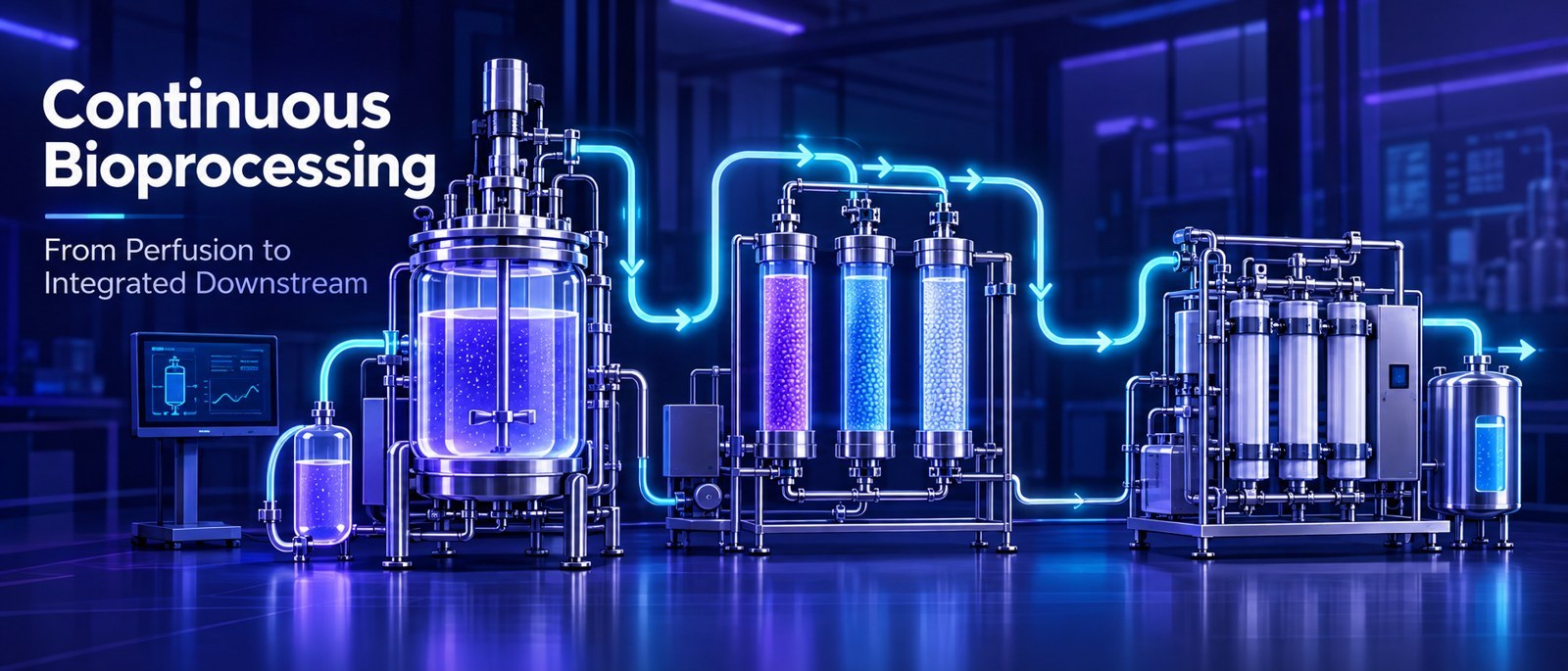
What ICH Q13 expects of integrated continuous bioprocessing, from state of control and run time to viral clearance, and what a 2017 model study found on cost and complexity, as of 27 November 2026.
Continuous bioprocessing is a spectrum, not a switch. A plant can keep a fed-batch bioreactor and run its capture step continuously, or run perfusion upstream and pass the harvest straight into connected purification. Each step along the way changes what the control strategy has to prove. This article draws on ICH Q13 (Step 4, November 2022), including its annex on therapeutic proteins, and on a 2017 Biotechnology Progress modelling study by Pollock and colleagues from University College London and Pfizer on integrated continuous antibody manufacture.
Last reviewed: 27 November 2026. ICH Q13 is a regulatory guideline. The 2017 study is a decision-model paper, so its outputs depend on its assumptions and are not measurements from a plant. Passages marked as interpretation are the author's analysis.
Terms: fed-batch, perfusion and continuous
ICH Q13 describes continuous manufacturing as the continuous feeding of input materials into, transformation of in-process materials within, and concomitant removal of output materials from a process. It notes that this can describe a single unit operation, such as process chromatography or perfusion cell culture, but that the guideline focuses on integrated systems in which two or more unit operations are directly connected, where a change in one operation may affect upstream and downstream operations and output quality. It applies to chemical entities and therapeutic proteins, including biosimilars and conversion of batch processes.
The 2017 study frames the options for monoclonal antibodies as batch, continuous or hybrid combinations for cell culture, capture and polishing. It describes fed-batch culture as the established platform choice for most antibodies, and its integrated continuous strategy as alternating tangential flow perfusion with continuous capture and continuous polishing. It also notes that fully continuous steady-state operation from bioreactor to final purification is not currently possible in biopharmaceutical manufacture, so what is practised is semi-continuous: some steps run continuously and others stay in batch.
On perfusion specifically, the 2017 study explains that cell retention devices have evolved from internal and external spin filters to tangential flow and alternating tangential flow (ATF) filtration, in which broth circulates back and forth between the bioreactor and an external hollow-fibre filter, to reduce filter fouling and avoid premature culture end. It reports that this enables higher cell densities and so higher productivity than earlier perfusion systems, that perfusion has historically carried more logistical and validation complexity and a higher likelihood of technical failure, and that newer retention devices aim to overcome this and to link with single-use bioreactors. The study does not give media consumption figures that this article could quote, so media use per unit of product is one input a plant has to measure for itself.
Control strategy: state of control, dynamics and traceability
Q13 makes several points that carry over to perfusion and integrated downstream. A state of control can be shown when parameters and quality attributes move within specified ranges, without being in a strict steady state, so the control strategy must detect drift and find its cause; Q13's example is a change in the elution profile of a therapeutic protein process caused by resin ageing. Process dynamics, including planned start-up, shutdown and pause and unplanned disturbances, should be characterised, for example by residence time distribution (RTD), which also supports tracking of material and the design of sampling and diversion. Input variability matters too: for an antibody process Q13 names lot-to-lot variability of cell culture media or feed components as a possible driver of performance and consistency.
On integration, Q13 says transfer steps should be evaluated including RTD, and design considerations include compatibility and integrity of components for the maximum run time or cycles, physical and digital interfaces between equipment, sampling and diversion points, and surge tanks, where RTD, uniformity and microbial risks should be evaluated and defined in advance. It defines batch size for continuous runs by output quantity, input quantity or run time at a defined flow, or as a range between minimum and maximum run time.
Monitoring, PAT and real-time release
Q13's therapeutic protein annex says continuous manufacturing lends itself to in-line sensors and online analysers, and that stronger in-line or online process analytical technology and automation support a release strategy that may include real-time release testing for some attributes. Its examples are in-line release tests for pH, osmolality and protein concentration and online tests for purity, charge heterogeneity, aggregation and low molecular weight impurities, at points shown to be critical for control. It adds that conventional offline testing remains necessary where no online or in-line method exists, such as potency, and that microbiological methods and other tests with long processing times may still be needed.
Contamination, run time and viral clearance
The annex is direct about the cost of long runs. Bioreactors in continuous mode may run much longer than batch bioreactors, the limit of in vitro cell age should be based on data from production cells expanded to that age or beyond, and a limit set for batch mode may not apply to continuous mode under different culture conditions. Run time considerations should include control of adventitious agents such as viruses, bacteria, fungi and mycoplasma, plus resin and membrane lifetimes, with viral testing under ICH Q5A and an appropriate microbial control strategy. Q5A recommendations for viral safety and clearance remain applicable, with scientifically justified alternatives permitted where they do not fit a continuous system. The main guideline adds that longer runs can reveal issues not seen over shorter runs, including process drift, material build-up, exceeding component limits such as validated cell age or resin cycle number, membrane or sensor fouling, and microbial contamination.
For equipment, the annex says single-use connections and components can see long durations or frequent change-outs and should be evaluated as contamination risks; filtration steps may run for longer, so filter changes and pre- and post-use integrity tests need a scheme that avoids interrupting the process, with a defined strategy for diversion and refiltration after a filter failure; and sampling locations should be chosen by risk to detect contamination without adding it.
Validation and regulatory considerations
Q13 says batch validation approaches also apply to continuous processes with added considerations for equipment performance over extended run times, integration of automation and material flow. For therapeutic proteins, consistency should account for variability between batches purified from harvests collected up to the cell age limit from a single cell bank thaw, and between harvests from multiple thaws, evaluated within validation or by alternative studies if justified. Continuous process verification may be considered when justified. Where material is diverted, for example at start-up and shutdown, Q13 expects the criteria and rationale to be defined in the quality system.
Interpretation: a useful reading is that Q13 turns three batch-era questions into time-based ones. How long can the cells and resins perform, how does a disturbance travel through connected steps, and which material do you divert when it does. A site that can answer those with RTD and run-time data has the core of a control strategy.
Changing output and converting from batch: what ICH Q13 says
ICH Q13 applies to continuous manufacturing of chemical entities and therapeutic proteins, including biosimilars and conversion of an existing batch process, and says its principles may also apply to other biological entities. It notes that perfusion cell culture can itself be an individual continuous unit operation, but the guideline focuses on systems where two or more unit operations are directly connected, so a change in one step can affect the steps upstream and downstream.
A continuous batch can be defined by the quantity of output material, the quantity of input material, or the run time at a defined mass flow rate, and a batch size can be a range, for example a minimum and maximum run time. The guideline lists four ways to change output, each with its own risks. A longer run time can expose process drift, material build-up, membrane or sensor fouling, microbial contamination and components exceeding validated limits such as cell age or resin cycle number. A higher mass flow rate can change process dynamics and may require re-evaluating the control strategy, traceability and diversion. Scale-out by replicating the whole line like-for-like follows the same control strategy, while parallel unit operations on one line add risks around flow distribution and re-integration of streams. Scale-up to larger equipment means the original control strategy must be reassessed at the new scale.
For converting an approved batch process, Q13 says output from the batch and continuous processes should have comparable quality, using a science- and risk-based approach to decide whether bioequivalence, non-clinical, clinical or stability data are needed. For therapeutic proteins it points to ICH Q5E for comparability. Manufacturers should seek regulatory approval before implementing the conversion. Because production output can change without a larger machine, Q13 also notes the chance to build process knowledge at commercial scale, which supports early validation work and continuous process verification as an alternative approach to process validation.
Footprint, productivity and complexity: what the model study says
Pollock and colleagues compared strategies with a decision tool combining cost of goods per gram, environmental impact, discrete-event simulation and operational risk scores. In their results, the integrated continuous strategy ranked best for early-phase production and small to medium companies, while for commercial production and companies with large portfolios the top strategy on cost of goods per gram became a hybrid: fed-batch culture with continuous capture and batch polishing. If operational feasibility was weighted above economics, the hybrid was preferred at all company scales. The authors state that process development costs for adopting continuous processing are outside the study's scope. These are model outputs for a generic two-column antibody process from 2017, not measured plant results, and later technology may shift them.
Illustrative scenario
This is a made-up example, not a named company. A mid-sized developer of a monoclonal antibody is deciding between perfusion with integrated downstream and a fed-batch process with continuous capture. It lists the run-time limits it would need to prove, the in vitro cell age data it would need to generate, the RTD of the connected steps, and the plan for diverting material at start-up. It decides to take the hybrid first: the continuous capture step teaches the team to manage RTD and diversion, and the cell age question stays a batch-mode one.
Decision points (interpretation)
- Which steps gain most from running continuously, and what disturbances move between them?
- What run-time limits are supported by data for cells, resins, membranes and filters?
- What is the diversion and sampling plan, and how is RTD known?
- Which release attributes can use in-line or online measurement, and which remain offline?
- Does the model comparison weigh operational complexity as well as cost of goods?
Related reading on Pharmaceutical Weekly: machinery, regulatory updates and continuous pharmaceutical manufacturing.