
Continuous pharmaceutical manufacturing: is the industry ready to move beyond batch production?
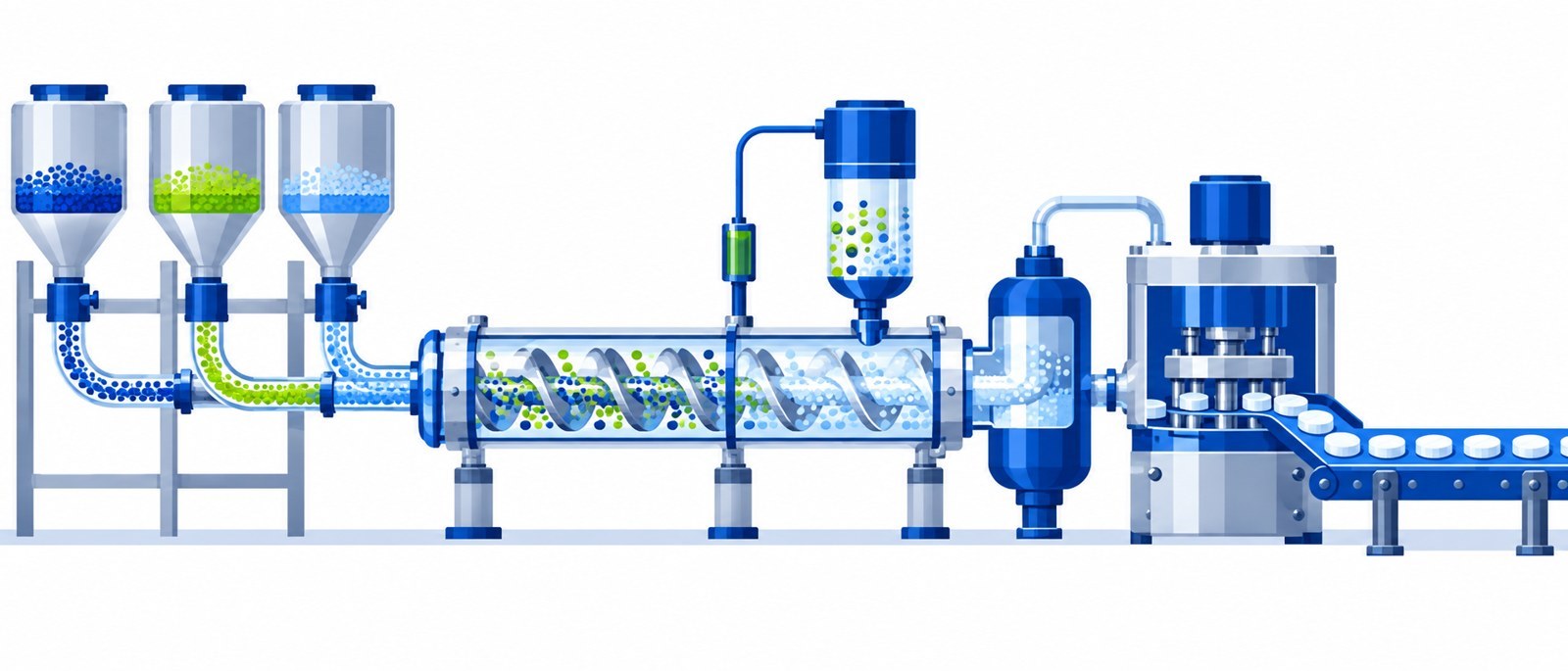
What ICH Q13 says about continuous manufacturing, plus the Indian GMP context: batch definition, control strategy, PAT, diversion and the regulatory path, as of 27 November 2026.
Whether a company is "ready" for continuous manufacturing is not a single yes or no. It depends on the product, the process and the quality system around it. What can be stated with certainty is what regulators have written down: ICH Q13, adopted in November 2022, sets out the scientific and regulatory considerations for continuous manufacturing (CM) of drug substances and drug products. This article uses that guideline to explain the business case, the technical hurdles and the regulatory path.
Last reviewed: 27 November 2026. Check the primary documents linked below before relying on any regulatory statement.
What counts as continuous manufacturing
ICH Q13 describes three modes: some unit operations run continuously while others stay in batch mode; all unit operations of a drug substance or drug product process are integrated and run continuously; or drug substance and drug product operations are integrated into a single continuous process. In any of these modes a process may use surge lines or tanks to keep material flowing at a constant rate. Conventional batch manufacturing, by contrast, processes a fixed quantity through each step in turn.
The guideline applies the ICH Q7 batch definition to CM. A batch can be defined by output quantity, input quantity, or run time at a defined mass flow rate, and it can be defined as a range, for example a minimum and maximum run time. Other definitions are possible if scientifically justified.
The technical building blocks
- State of control. ICH Q13 notes that a state of control can be shown even when parameters move within specified ranges and the process is not strictly in a steady state. The control strategy must detect drift and trends and look for their root cause, such as input variation, equipment fatigue or material ageing.
- Process dynamics and residence time distribution (RTD). The guideline asks developers to characterise how transient events, planned (start-up, shutdown, pause) or unplanned (disturbances), affect output quality. RTD is given as one way to do this.
- Process analytical technology (PAT). The guideline calls PAT well suited to CM. Its examples include in-line UV flow cells, in-line near-infrared spectroscopy for blend uniformity or water content, and on-line HPLC to monitor reaction conversion. PAT lets disturbances be detected in real time, which makes automated feedforward or feedback control possible.
- Material traceability and diversion. Knowing the RTD lets a manufacturer trace input materials through the line and decide when to start and stop collecting product or divert it. Criteria for the start and end of diversion should be set in advance, and the diversion strategy should account for its own effect on flow.
- Real-time release testing (RTRT). Where used, in-process data can support assessment of batch quality. The guideline also asks for a risk assessment of data gaps, such as PAT recalibration or a feeder refill.
The business case: what to test, not assume
Claims about footprint, cycle time, throughput and consistency should be tested against your own product and site, not taken as a given. ICH Q13 does say system design can enable process intensification and shorter cycle times, and that production output can be increased by longer run time, higher mass flow rates, duplicating equipment (scale-out) or larger equipment (scale-up), each with its own risks to process dynamics and the control strategy. A sensible business case therefore compares, for a named product: capital cost, development effort, expected run times, batch definition, the cost of diversion, and what changes in the supply plan.
The regulatory path
ICH Q13 reached Step 4 on 16 November 2022. The European Medicines Agency lists the guideline with a legal effective date of 10 July 2023. For an approved batch product, the guideline says manufacturers should seek regulatory approval before converting it to CM, and can ask the regulator for advice on the strategy and data package. For an application, expect to describe the process flow, start-up, shutdown, pause and restart procedures, the collection and diversion strategy, and the control strategy.
In the United States, FDA's notice on its Advanced Manufacturing Technologies Designation Program describes CDER's FRAME initiative, which prioritised four technologies: end-to-end continuous manufacturing, distributed manufacturing, point-of-care manufacturing, and the use of AI in manufacturing. That is a statement of regulatory priority, not a requirement.
The position for Indian manufacturers
ICH Q13 is the reference text regulators in ICH regions use. Indian manufacturers should confirm with CDSCO or the State licensing authority how a continuous process would be assessed against it. The wider Indian GMP context is as follows.
- Revised Schedule M. The Government of India revised Schedule M of the Drugs Rules, 1945 by G.S.R. 922(E) dated 28 December 2023, upgrading it to cover good manufacturing practices and requirements of premises, plant and equipment. According to the Press Information Bureau (24 March 2026), it became effective for manufacturers with turnover above Rs. 250 crore from 29 June 2024 and, for those with turnover of Rs. 250 crore or less, from 1 January 2026. An earlier PIB release (12 February 2025) records a conditional extension to 31 December 2025 for small and medium manufacturers that submitted an upgrade plan. Check the current Gazette text and your licensing authority for the position that applies to your site.
- Government view of continuous manufacturing for APIs. A Department of Pharmaceuticals survey report on technologies to reduce API production cost and import dependence (published March 2023, covering 50 API manufacturers through interviews) says continuous manufacturing, catalysis and solvent recycling need to be adapted by industry, and describes continuous manufacturing as lowering running cost and human handling. That is the survey authors' view, not a regulatory requirement, and it is not tested against any specific plant.
Interpretation: an Indian manufacturer designing a continuous line for a product sold in the EU, US or other ICH markets can plan to ICH Q13 and the importing market's regulator, while meeting Schedule M for the Indian licence. For the Indian filing itself, early engagement with CDSCO is the safe course.
Risks and implementation
- Process understanding. You need to know how disturbances move through the line before you can write a credible diversion strategy.
- Sampling and measurement. The guideline warns that measurement and physical sampling must not interfere with the material stream.
- Models. Where process models are used, ICH Q13 expects routine model maintenance and monitoring of performance, especially after a process change.
- Stability and scale. If output is increased by anything other than run time, applicants should justify how they define primary stability batches.
- Product fit. The guideline covers small molecules and therapeutic proteins; the examples in its text include both. Your own product's chemistry, form and volume decide whether the benefits outweigh the effort.
Illustrative scenario
This is a made-up example, not a named company. A site making a high-volume tablet considers moving its blending and compression steps to a continuous line. It first maps RTD for the blender, sets criteria for when the line collects or diverts material, and fits in-line near-infrared measurement for blend uniformity. It then runs the new line in parallel with the validated batch process, and talks to the regulator before filing a conversion.
What to evaluate next
- Pick one product and write down why continuous manufacturing might suit it.
- Define the batch (output, input or run time) before designing the line.
- Characterise process dynamics and RTD, then set diversion criteria.
- Choose PAT tools for the attributes that decide release.
- Plan the regulatory conversation early, including stability batches.
Related reading on Pharmaceutical Weekly: our regulatory updates, the machinery section, and the earlier article on continuous API manufacturing with flow chemistry and AI process control.