
Pharmaceutical cold chain 2.0: real-time monitoring, lane qualification and excursion management
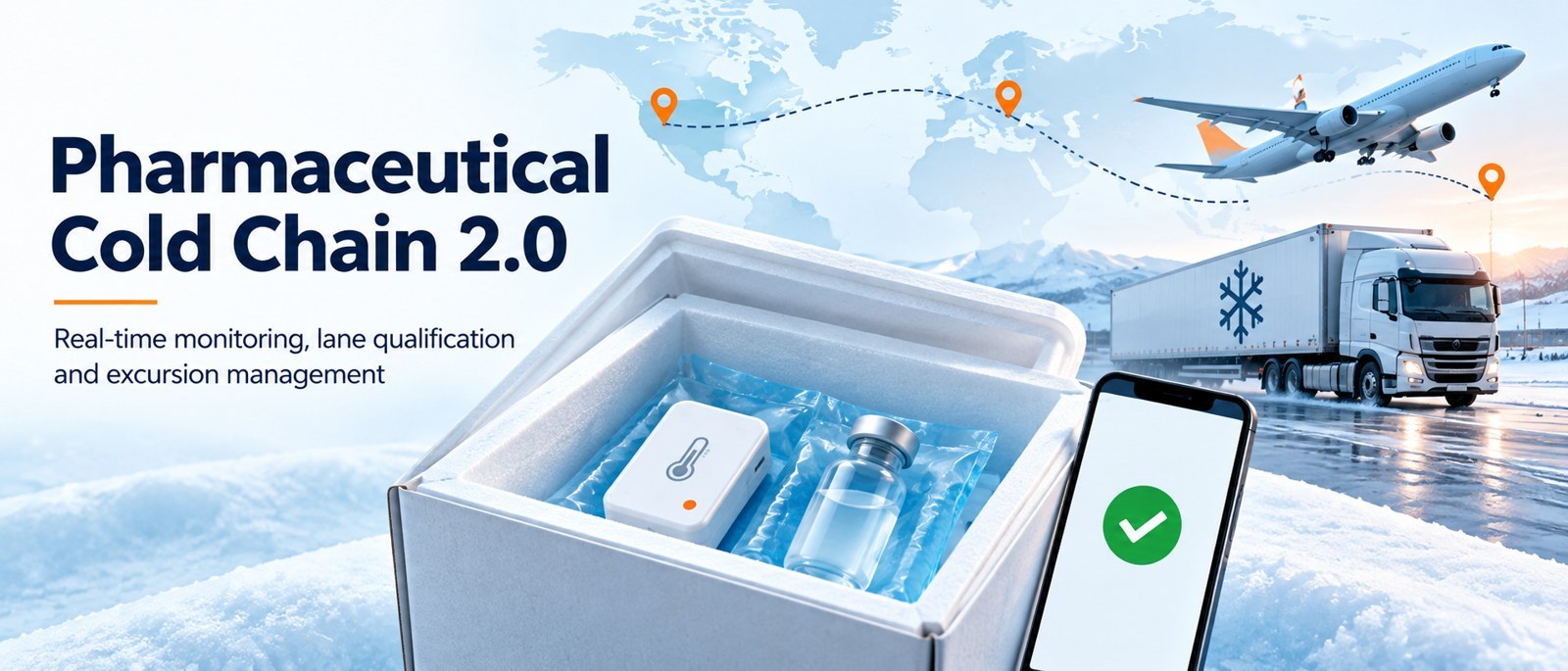
What the EU Good Distribution Practice guidelines and WHO Annex 9 require for mapping, qualified packaging, monitoring and excursion handling, and how a team can turn them into a response workflow, as of 27 November 2026.
A medicine that leaves the plant in range can still arrive out of range. Distribution is where small gaps in mapping, packaging and records turn into product-quality questions. This article draws on two regulatory texts: the European Commission Guidelines of 5 November 2013 on Good Distribution Practice (GDP) of medicinal products for human use, and WHO Technical Report Series 961, Annex 9, the model guidance for the storage and transport of time- and temperature-sensitive pharmaceutical products (TTSPPs). Neither is a survey of industry practice, so no statement here describes how common any control is.
Last reviewed: 27 November 2026. Passages marked as interpretation are the author's analysis, not requirements of either text.
Ranges come from the product, not the lane
WHO Annex 9 defines a temperature excursion as an event in which a TTSPP is exposed to temperatures outside the range prescribed for storage or transport. It requires that products travel so that excursions above or below the manufacturer's labelled storage range do not harm quality, and it says plainly that product stability data must demonstrate the acceptable excursion time during transport. A controlled room temperature, refrigerated or frozen product therefore has its allowed range set by its labelling and stability data. A lane, a shipper or a logger does not define it.
Mapping, qualification and seasonal lanes
EU GDP asks for an initial temperature mapping exercise on a storage area before use, under representative conditions. Monitoring equipment should sit where the mapping found the extremes, and mapping should be repeated according to a risk assessment or after significant changes to the facility or the temperature-control equipment. For transport, the guidelines say temperature-sensitive products need qualified equipment such as thermal packaging, temperature-controlled containers or temperature-controlled vehicles. Where vehicles are used, monitoring equipment is maintained and calibrated at regular intervals and mapping under representative conditions takes seasonal variations into account.
WHO Annex 9 is more detailed. It asks users to profile and qualify transport routes, and to qualify each owned or operated temperature-controlled road vehicle before use, showing that air temperature distribution stays within limits across the compartment for commonly used load layouts and at the ambient extremes expected over known routes. For insulated passive containers it asks for qualification of the whole assembly, including coolant, gel packs, phase change materials, partitions and dunnage. The qualification should record the packaging assembly, the thermal conditioning regime, the minimum and maximum volume, weight and thermal mass the container can hold, and the correct placement of monitors. It also has to account for the route and the expected ambient profile from departure to arrival in the recipient's temperature-controlled store. Active containers must likewise be shown to hold the stability range over the same journey.
Container selection in EU GDP rests on the storage and transport requirements, the expected external temperature extremes, the longest expected transit time including any storage at customs, and the qualification status of the packaging.
Passive and active shippers, coolants and pack-out
WHO Annex 9 defines passive systems as insulated enclosures that hold temperature using a finite amount of pre-conditioned coolant, such as chilled or frozen gel packs, phase change materials, dry ice or others. Active containers regulate temperature by powered means. Both have to be qualified for the product's stability range. Clause 6.8.3 on passive containers names the ancillary items inside the qualification: temperature stabilising medium, dry ice, ice or gel packs, cool water or warm packs, phase change materials, partitions, bubble wrap and dunnage. The text does not rank one coolant over another, and it does not give coolant quantities or conditioning times. Those come from the qualification of each assembly.
Clause 6.9 then asks that shipping containers are packed to the exact specified configuration, so the shipper behaves as it did when it was qualified. The same clause asks users to protect freeze-sensitive products against temperatures below 0 °C when frozen packs are used, to protect products against the adverse effects of dry ice, to label containers with the correct transport temperature range and orientation, and to label packages containing dangerous goods, dry ice included, as transport regulations require.
The word "refrigerants" appears in Annex 9 in another place. Clause 10.2 covers refrigeration equipment for temperature-controlled storage and transport, and asks that new equipment uses refrigerants that comply with the Montreal Protocol, minimises refrigerants with high global warming potential and limits leakage during installation, maintenance and decommissioning. Annex 9 does not name specific refrigerant substances, and neither does this article. That is a separate matter from the gel packs and phase change materials inside a passive shipper.
Interpretation: neither text gives product-specific temperature bands for room-temperature, refrigerated or frozen goods, so the band for any product is taken from its own label and stability data. The pack-out question for a distributor is then practical: which qualified assembly, conditioned in which way, matches the label band and the longest expected journey.
Monitoring, alarms and calibration
EU GDP requires calibration traceable to a national or international measurement standard, alarm systems that warn of excursions from pre-defined conditions, alarm levels set appropriately, and regular tests of the alarms. WHO Annex 9 says to use chemical or electronic freeze indicators, electronic loggers with or without alarms, or other suitable indicators in passive and active shippers, to prefer them for external distribution and to document the indicator status on arrival. It says the recording frequency should take account of the logger's storage capacity and the expected transport period, and notes that electronic logger records are usually encrypted and protected by checksums.
Interpretation: neither text prescribes real-time connected sensors. The practical value of live data is that an alarm can reach a person while the shipment can still be acted on, rather than at the destination. The connection gaps the brief asks about, such as a shipment in a customs hold or a cargo hold, are then a design risk: the plan needs a rule for what happens when data stops, such as a logger that stores readings for download on arrival.
Handoffs, last mile and documents
EU GDP says that if a deviation such as a temperature excursion has occurred in transport, it should be reported to the distributor and the recipient, and that a procedure for investigating and handling excursions should exist. Contract acceptors must not do anything that could harm the quality of the products handled for the contract giver. If requested, customers are to be given information showing that products complied with the temperature conditions. WHO Annex 9 asks receivers to quarantine products that experienced unacceptable excursions, not to release them until checks are complete and to keep temperature and humidity records, with records kept for the period local law sets and no less than three years.
A sample excursion response workflow (interpretation)
- Alarm or arrival check shows a reading outside the labelled range. Quarantine the affected shipment.
- Collect the full logger record, pack-out details, lane and handoff times, and calibration status of the logger.
- Compare duration and extent of the excursion with the product stability data that supports an acceptable excursion time.
- The quality unit decides on the disposition and records the reasoning. Goods do not move to saleable stock until that is complete, as WHO Annex 9 requires for unacceptable excursions.
- Report the deviation to the distributor and recipient, and to the marketing authorisation holder where defects are involved.
- Review the lane or pack-out: was the qualification still representative for the season and the route?
Illustrative scenario
This is a made-up example, not a named company. A distributor ships a refrigerated product by road and air in July using a passive shipper that was qualified in winter. A logger alarm sounds at the transfer hub, and the receiving site quarantines the pallet on arrival. The quality unit finds the reading was out of range for a period shorter than the stability data supports, records that decision, releases the goods and asks the team to re-qualify the pack-out for summer ambient conditions.
Related reading on Pharmaceutical Weekly: regulatory updates and data integrity in GMP.