
Amorphous solid dispersions: enabling poorly soluble drugs through formulation engineering
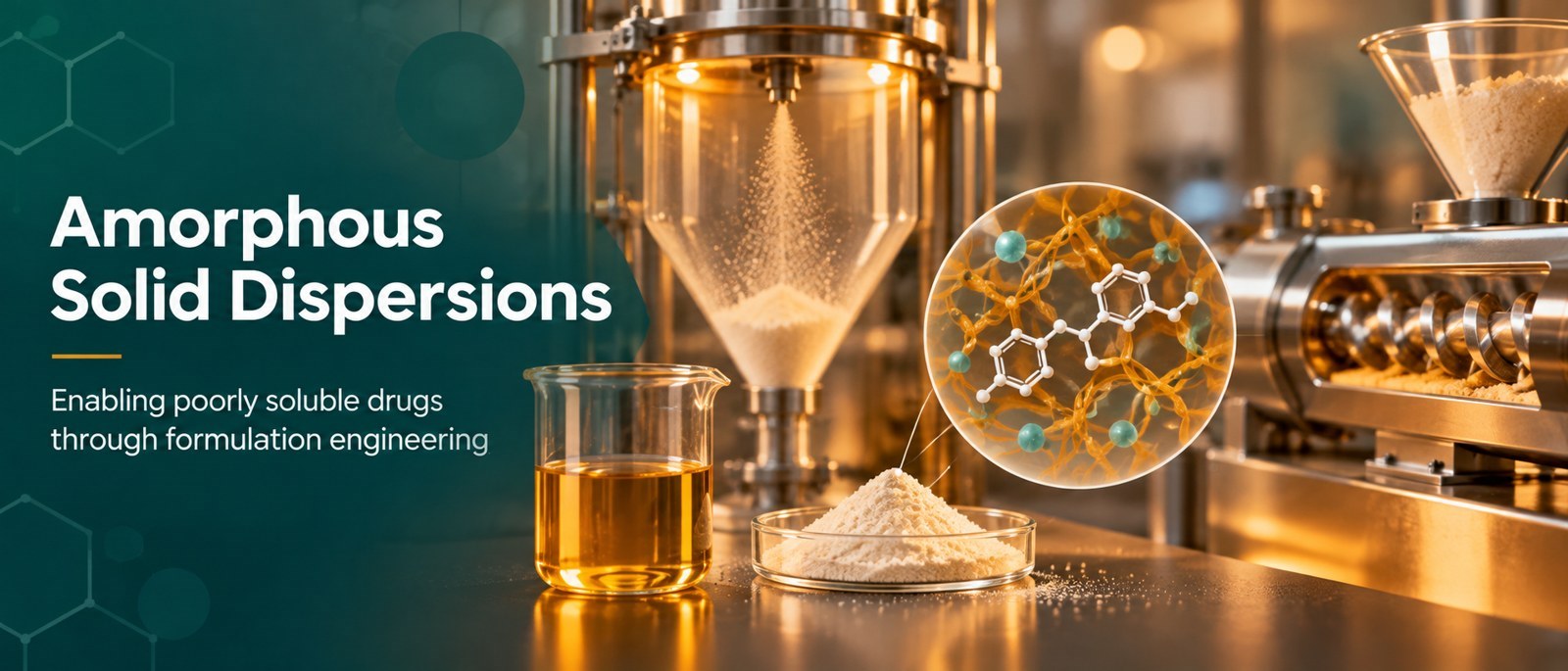
How amorphous solid dispersions raise apparent solubility, how spray drying and hot-melt extrusion compare, and what manufacturers must control, based on three peer-reviewed reviews, as of 27 November 2026.
When a drug dissolves too slowly or too little in the gut, absorption suffers however good the molecule is. An amorphous solid dispersion (ASD) is one answer: the drug is held in a mostly non-crystalline state, usually inside a polymer. This article draws on three peer-reviewed reviews: a review of ASD manufacturing strategies, a review of quality by design for hot-melt extrusion ASDs from an industrial perspective, and a 2022 review of preformulation, formulation and characterisation advances. They are reviews of published studies and do not measure how common any practice is across industry.
Last reviewed: 27 November 2026. Passages marked as interpretation are the author's analysis, not findings of the reviews.
Why the amorphous form helps
The manufacturing-strategies review states that, relative to the crystalline form, the amorphous form of many poorly water-soluble drugs can achieve substantially higher apparent solubility and markedly faster dissolution. It also notes that ASDs are known to give higher membrane flux because of higher supersaturation, which can improve bioavailability. The reason for the benefit is also the reason for the risk: below its melting point, the amorphous form has higher free energy than the crystal, so there is a thermodynamic drive to crystallise. Because the drug in an ASD is often supersaturated, the review adds that it is important to reduce molecular mobility to delay phase separation and crystallisation.
Routes of preparation
The same review groups most methods by principle. Solvent evaporation methods include spray drying, electrospraying, fluidised bed drying, supercritical fluid methods and spray freeze-drying, as well as many laboratory-scale approaches. Because evaporation usually runs well below the drug's melting point, it suits thermolabile drugs. For spray drying, the review reports that two-fluid nozzles have been the most common choice, particularly at laboratory scale, that pressurised nozzles give larger particles with better flow and are easy to scale up, and that spray drying can produce particles from nano to micro scale in a very short time. One of its stated concerns is residual solvent: the amount left in the product must meet the ICH Q3C(R6) limits, and removal matters most when toxic organic solvents are used. It also warns that binary solvents with different evaporation rates can cause variable supersaturation and uneven precipitation during drying.
Hot-melt extrusion (HME) is solvent-free. The industrial-perspective review describes it as an industrially feasible approach and explains that the extruder has a barrel, feeder and screw elements; conveying and kneading elements mix and move the material and push the melt through a die. The 2022 review adds that HME runs at temperatures typically above the glass transition temperature (Tg) of the polymers and sometimes well above the drug's melting temperature, that plasticisers can lower the processing temperature, and that DSC-based material-sparing methods have been proposed to find suitable loading and temperature. The same review notes that most marketed ASD products are made by hot-melt extrusion or spray drying. A reported case of degradation during extrusion in the manufacturing-strategies review, despite earlier forced degradation and thermal testing, is a reminder that heat stability must be confirmed under real process conditions.
Polymer, drug loading and miscibility
The manufacturing-strategies review explains that an ASD typically has a Tg between that of the drug and that of the polymer, and that moisture lowers Tg through a plasticising effect that raises molecular mobility and crystallisation risk. It reports that a drug in an ASD showing amorphous-amorphous phase separation can crystallise faster than one in a fully miscible system, and that at some drug loadings dissolution is controlled by the polymer rather than the drug. In its examples, phase separation was subtle at 25% loading for ritonavir with a PVP-VA polymer, and had little effect on release at high loadings, where release was already compromised. The HME review shows how polymer ratios were screened with designed experiments: itraconazole with HPMCAS and added surfactant or hydrophilic carrier, and ziprasidone hydrochloride with Plasdone S-630 and HPMCAS-HF in a 13-run design. The 2022 review gives a spray-dried example using Eudragit L100 (Tg 150 °C) at 65% w/w drug load, later granulated with HPMCAS and compressed.
Stability, moisture and packaging
The industrial-perspective review warns that during storage the product may take up water, which lowers the drug's solubility in the polymer and raises the risk of recrystallisation and phase separation, and that humidity studies can help predict long-term stability of binary and ternary dispersions. The 2022 review concludes that proper selection of ingredients, manufacturing process, process parameters and packaging components is essential to a stable ASD product. None of the reviews read gives packaging specifications, so the practical conclusion below is interpretation.
Characterisation
The 2022 review states that DSC and powder X-ray diffraction still play a major role in detecting crystallinity, with newer methods such as nano-tomography, transmission electron microscopy, atomic force microscopy, X-ray microscopy and terahertz spectroscopy giving submicron detail on structure and drug-polymer interaction. It describes Raman mapping as highly sensitive for crystallinity in 3D-printed tablets and filaments, and cites a study in which DSC and XRPD showed ASDs in printed tablets stayed amorphous for 23 weeks at room temperature and 37% relative humidity. The manufacturing-strategies review also reports that spray-dried naproxen-PVP-VA samples taken from different parts of a dryer showed different glass transition widths, which it reads as different miscibility. Dissolution testing is the functional test of the benefit itself.
Illustrative scenario
This is a made-up example, not a named company. A team has a poorly soluble candidate and compares two prototypes: a spray-dried dispersion and an extrudate with the same polymer. The extrudate shows a small amount of degradation at the barrel temperature, so the team adds a plasticiser to lower it. The spray-dried version meets its residual solvent limit but shows crystallinity by XRPD after humidity storage in an open dish. The team chooses the route whose dissolution holds after a humidity challenge and tests it again in the intended pack.
Selection criteria and failure modes (interpretation)
- Heat sensitivity of the drug points toward solvent routes; solvent hazards and residual solvent limits point toward extrusion where the drug tolerates heat.
- Drug loading is a trade-off: higher loading means smaller dose volume but, as the reviews show, greater risk of phase separation and polymer-controlled release.
- Failure modes in the sources are crystallisation on storage, moisture-driven Tg loss, phase separation, thermal degradation and solvent residues; each needs a named control and a test.
- Characterisation should combine a crystallinity method (DSC, XRPD) with a functional method (dissolution) and a stability study in the final pack.
Related reading on Pharmaceutical Weekly: materials and the future of pharmaceutical excipients.