
AI in pharmaceutical manufacturing: from pilot projects to validated production systems
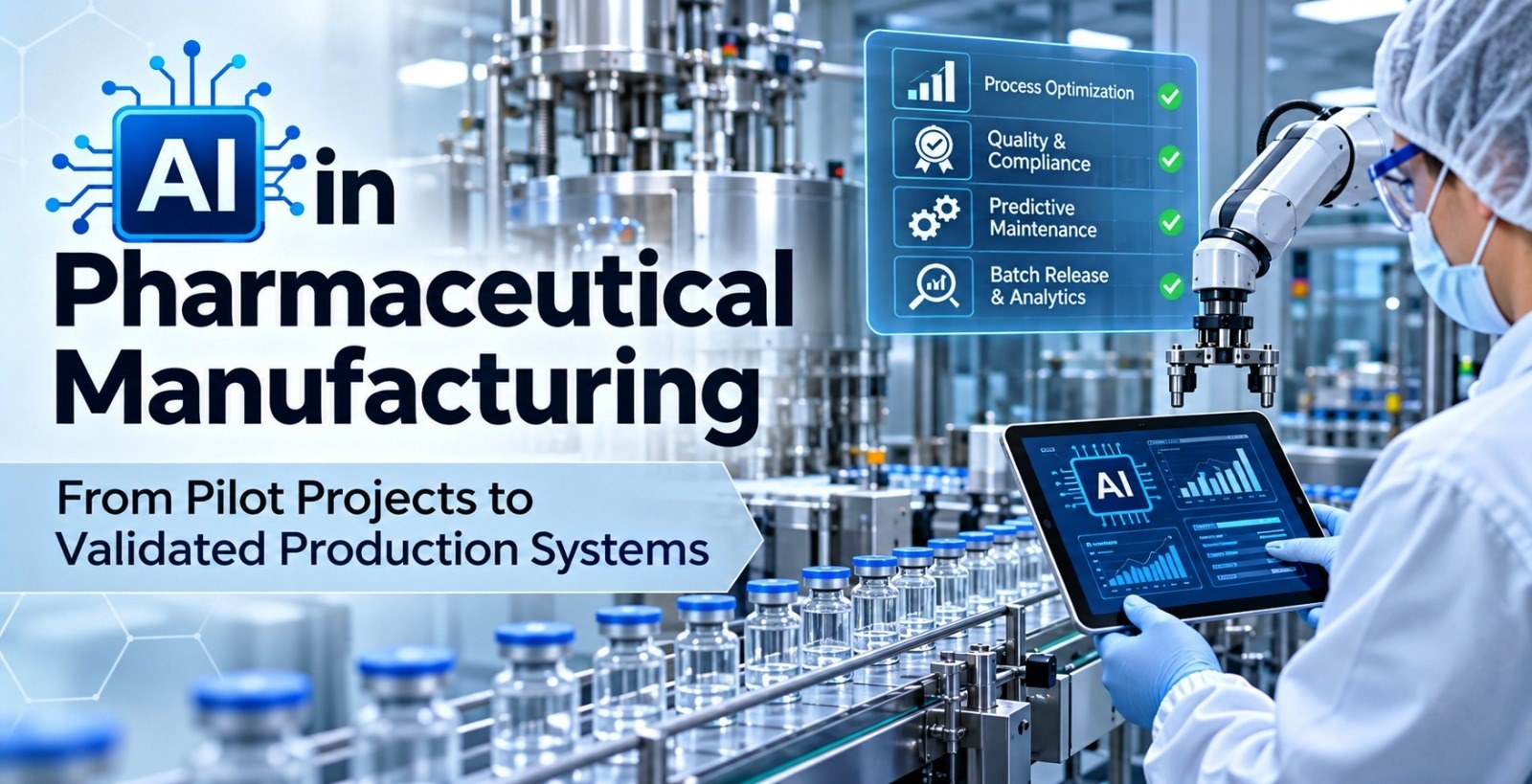
How pharma manufacturers can deploy AI without compromising data integrity, product quality or regulatory compliance, and where EU and FDA rules stand as of 27 November 2026.
A team that has built an AI pilot, such as a camera that flags vial defects, a model that sorts deviation reports or a predictive-maintenance alert on a filling line, faces a different question when it wants to use it in routine production: what evidence will the quality unit, an auditor and a regulator accept? This article sets out what the current regulatory documents say about that evidence, and where the rules are still moving.
Last reviewed: 27 November 2026. Regulatory status changes quickly; check the primary documents linked below before relying on them.
Three kinds of "AI" that GMP treats differently
Deterministic automation follows rules a person wrote. The same input always gives the same output, and classic validation applies. Machine learning learns its behaviour from training data, so validation has to test the model against data, not only the code. Generative AI, including large language models, can give different answers to the same input. The draft Annex 22 treats that difference as a risk in itself, as described below.
The European draft Annex 22 draws this line clearly. It covers machine-learning models used in critical GMP applications, meaning applications with direct impact on patient safety, product quality or data integrity. It covers static models (they do not keep learning in use) with deterministic output. For dynamic models and for models with probabilistic output, the draft says they should not be used in critical GMP applications. It says the same of generative AI and large language models. If they are used in non-critical applications, qualified personnel remain responsible for the output.
Where the rules stand
- EU and PIC/S. Annex 22 was released as a draft with revised Annex 11 and Chapter 4 for consultation from 7 July to 7 October 2025. In 2026 the European Medicines Agency held a workshop (30 June and 1 July) to gather expert views on possible safeguards for generative AI, and said it was still considering the consultation results. On the sources we checked, Annex 22 is still a draft and not binding.
- FDA. The January 2025 draft guidance on AI to support regulatory decision-making proposes a seven-step credibility framework, where the level of evidence rises with model risk (how much the decision depends on the model, and how serious a wrong decision would be). It is a non-binding draft. It does not address AI used for operational efficiencies, such as internal workflows, that do not affect patient safety, drug quality or the reliability of results.
- FDA and EMA together. In January 2026 the two agencies published ten shared principles for good AI practice in drug development. They include a risk-based approach, a clearly defined context of use, documented data governance, and life-cycle management that includes monitoring for data drift.
- Industry guidance. ISPE published its GAMP Guide: Artificial Intelligence in July 2025. FDA's computer software assurance guidance applies to medical-device production and quality-system software, not to drug manufacturing, but it shows the same risk-based way of thinking.
What this means on the shop floor
A practical reading of these documents, and our interpretation rather than a rule, is that the use case decides the effort. A model that recommends and a person who decides needs lighter evidence than a model that accepts or rejects product on its own.
- Visual inspection (accept or reject). Direct effect on product quality. Expect full validation against a labelled test set, with acceptance criteria no worse than the manual or rule-based process it replaces.
- Deviation triage. Can be set up to support a human decision. Define what the model may suggest and what the quality unit must decide.
- Predictive maintenance. Can carry lower risk, unless a missed alert could affect product quality or data integrity.
- Process monitoring and yield optimisation. Depends on whether the model only advises or adjusts the process. Adjusting a validated process brings change control into play.
The draft Annex 22 asks for specific things. Write down the intended use in detail, including rare and erroneous inputs, with a process expert responsible for that description. Set metrics and acceptance criteria before testing. Use test data that covers the full range of use, is large enough for the metrics to mean something, has verified labels, and is kept independent from training data. Even before the annex is final, they are a useful way to test whether a use case is ready, because they follow the same risk-based logic as the FDA and EMA documents above.
Human oversight, explainability, audit trails and access: what the draft Annex 22 asks
The consultation text of draft EU Annex 22 gives concrete wording for these points, for models that predict or classify data in critical GMP uses. It does not apply to generative AI and large language models, which it says should not be used in critical GMP applications. In non-critical uses without direct impact on patient safety, product quality or data integrity, it says qualified personnel should always be responsible for confirming the outputs suit the intended use, a human in the loop.
Human oversight. Where a model gives an input to a decision made by a human operator and the effort to test the model has been reduced, the intended-use description should state the operator's responsibility, and the operator's training and consistent performance should be monitored like any other manual process (section 3.3). Records of this human review should be kept, which, depending on criticality and the level of model testing, can mean consistent review or testing of every output (section 10.5).
Explainability. During testing of models in critical GMP applications, systems should capture the features in the test data that contributed to a classification or decision such as a rejection, using techniques such as feature attribution (SHAP values or LIME) or heat maps where applicable. A review of those features is to be part of the approval of test results, to confirm the model decides on relevant features (section 8). The draft also asks the system to log a confidence score for each prediction and to use a threshold so that a very low score can be flagged as "undecided" instead of producing an unreliable result (section 9).
Audit trails and access. Test data is to be protected by access control and by audit trail functionality that logs accesses and changes, with no copies outside the repository. People who developed or trained the model should never have had access to its test data, and the draft sets out a four-eyes arrangement for staff who did (section 6). Documentation of access control and the related audit trail records is retained like other GMP documentation (section 7.4). Personnel should have defined responsibilities and an appropriate level of access (section 2.1).
Drift and change. The performance of a model against its metrics should be monitored regularly, for example for a change in lighting, and input data should be monitored against the model's sample space and intended use, with metrics defined for drift (sections 10.3 and 10.4). A tested model, its system and the process it supports go under change control and configuration control before deployment, and a decision not to retest after a change must be justified (sections 10.1 and 10.2).
This is a consultation draft and may change before it is adopted.
Risks and implementation
Four risks are worth planning for. First, data governance: if you cannot trace where training and test data came from, the validation has nothing to stand on. Second, suppliers: the draft expects the regulated user to hold and review the documentation even when a vendor trained the model. Third, drift and change: a model that performed well at qualification can degrade as materials, equipment or lighting change, so define monitoring and retraining triggers under change control. Fourth, over-reliance: where a person reviews model output, their training and performance should be monitored like any other manual step.
Illustrative scenario
The following is a made-up example, not a named company. A packaging line replaces a manual check for missing leaflets with a camera model. The team first measures the manual error rate over several months. They then set an acceptance target at or above that rate, test on images that include rare faults and poor lighting, and run the model alongside inspectors before it makes any decision. After go-live, a monthly check compares model decisions with a sample of human review, and a lighting or camera change triggers requalification.
A short checklist for a first validated use case
- Pick one narrow use case with a clear owner in quality.
- Measure the current process first, so there is a baseline to beat.
- Write the intended use, input limits and human responsibilities.
- Fix test metrics and acceptance criteria before testing.
- Run in shadow mode before the model acts on its own.
- Define monitoring, drift limits and change control before go-live.
- Keep supplier and training-data documentation in your own quality system.
For related reading on Pharmaceutical Weekly, see our regulatory updates, the machinery and resources sections, and our earlier piece on continuous API manufacturing with AI process control.